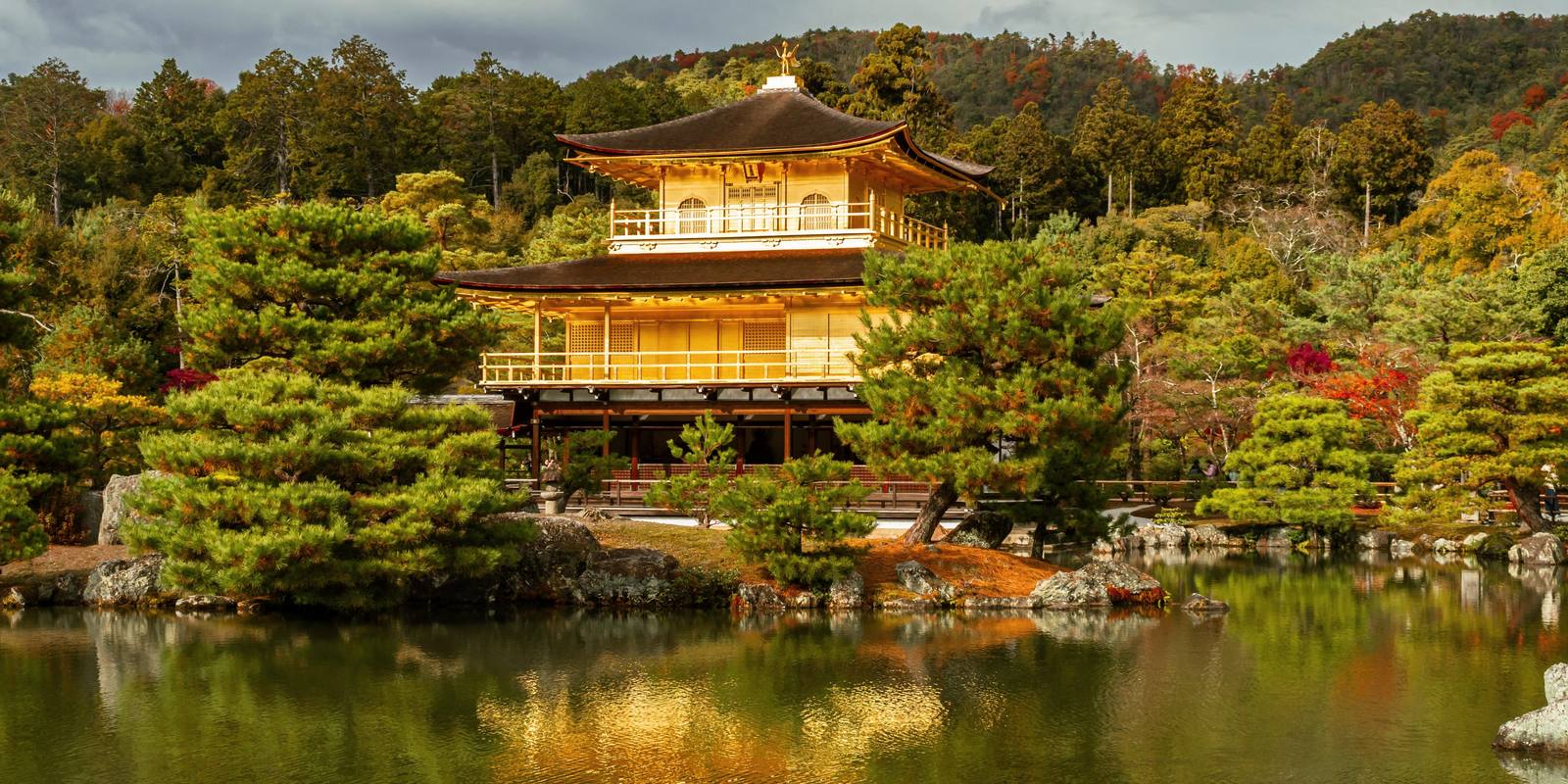
Most Kyoto trips are built around a date that nobody can actually fix. Cherry blossom and autumn colour are the two reasons people come, and both move — by a week in an ordinary year, by a fortnight in an unusual one. Kyoto weather also behaves differently from the coastal Japan most visitors know, because the city sits in a basin ringed on three sides by hills. That geography is why its peaks arrive on their own schedule, and why its summers are harder than the map suggests.
Why Kyoto Is Not Coastal Japan
Kyoto lies in a shallow basin with hills to the north, east and west, and only a narrow opening to the south. Air moves through it slowly, and that single fact drives most of what makes the city’s weather distinctive.
- Summers are hotter and stickier. Without a sea breeze to clear it, warm humid air settles and stays. August averages 33°C (91°F) with humidity above 70%, and evenings cool far more slowly than on the coast — the reason Kyoto summers have a reputation that the numbers alone do not explain. Our guide to humidity covers why that combination punishes so much more than heat alone.
- Winters are colder. Clear, still nights let heat escape, so January mornings near 1°C (34°F) are common despite Kyoto sitting further south than Tokyo.
- Mornings hold mist. Cool air pools in the basin overnight, and in autumn the temple districts and the northern hills sit under mist until mid-morning — the single best photographic condition Kyoto offers.
- The seasons shift. Warmer city air brings blossom on slightly earlier than the surrounding countryside, while the hills north of the city turn colour one to two weeks before the city centre does.
The Two Windows, and Why They Move
Blossom and colour are not calendar events. Both are triggered by accumulated temperature in the weeks beforehand, which is why the dates drift year to year and why no guidebook can give you a fixed answer.
Cherry blossom usually opens in the last days of March and peaks in the first week of April. The full-bloom window is genuinely short — often four to seven days — and heavy rain or wind can end it early. A warm February and March pull it forward; a cold spring pushes it back.
Autumn colour typically peaks between about 15 and 30 November, and behaves far more forgivingly. It moves down from the northern hills into the city over roughly two weeks, so if you miss it in one district you can usually find it in another. The display lasts weeks rather than days.
Forecasts are published for both — from January for blossom, September for colour — and refined as the season nears. They are directional rather than precise, and worth treating the way you would any long-range forecast: our guide to how accurate a weather forecast is sets out how much weight they carry.
How to Plan Around a Date That Moves
The practical problem is that flights and accommodation must be booked months before anyone knows the dates. Here is how to handle that at each stage.
| If You Are | The Risk | What To Do |
|---|---|---|
| Booking 6+ months out | Dates unknowable; peak-week prices | Target the first week of April or the third week of November. These are the safest single bets in a normal year. |
| Booking 2–3 months out | First forecasts published, still coarse | Book flexible accommodation. Colour forecasts are more reliable than blossom ones at this range. |
| Booking 2–4 weeks out | Forecast now reasonably firm | Commit. This is when the blossom window becomes genuinely predictable. |
| Already booked, wrong week | Missing the peak entirely | For colour, move north or to higher ground — the hills turn earlier. For blossom, later-flowering varieties extend the season by a week. |
| Chasing blossom specifically | Rain or wind ending it early | Build a two-week window rather than a long weekend, and treat the trip as a Kyoto trip that may include blossom. |
The asymmetry is worth internalising: colour is a season, blossom is an event. If your dates are inflexible and you want certainty, November is the better gamble by a wide margin.
Kyoto Weather Month by Month
For reference, average highs and lows, rain days and humidity. Scroll the table sideways on mobile.
| Month | High | Low | Avg Rain Days | Avg Humidity | In A Word |
|---|---|---|---|---|---|
| January | 9°C (48°F) | 1°C (34°F) | 9 | 65% | Cold, dry and very quiet |
| February | 10°C (50°F) | 1°C (34°F) | 9 | 63% | Cold; plum blossom late month |
| March | 14°C (57°F) | 4°C (39°F) | 11 | 60% | Warming; blossom watch begins |
| April | 20°C (68°F) | 9°C (48°F) | 11 | 58% | Blossom peak in the first week |
| May | 25°C (77°F) | 14°C (57°F) | 11 | 62% | Warm, green and underrated |
| June | 28°C (82°F) | 19°C (66°F) | 13 | 72% | Tsuyu — the plum rains |
| July | 32°C (90°F) | 23°C (73°F) | 12 | 75% | Hot, humid, heavy downpours |
| August | 33°C (91°F) | 24°C (75°F) | 9 | 72% | Hottest; humidity at its worst |
| September | 29°C (84°F) | 20°C (68°F) | 12 | 72% | Typhoon risk; heat easing late |
| October | 23°C (73°F) | 14°C (57°F) | 8 | 68% | Excellent; first colour in the hills |
| November | 17°C (63°F) | 8°C (46°F) | 7 | 68% | Colour peaks in the second half |
| December | 11°C (52°F) | 3°C (37°F) | 7 | 66% | Cold, crisp and uncrowded |
Travelling Outside the Two Peaks
Both peak windows bring extreme crowds and the highest accommodation prices of the Japanese year. The months either side are, for many visitors, the better trip.
- May is the most underrated month in Kyoto. Average highs of 25°C (77°F), everything green, comfortable walking, and none of the April crush.
- October gives near-perfect conditions — 23°C (73°F), the driest month of autumn, first colour appearing in the northern hills — before the November rush arrives.
- December to February is cold but bright and genuinely quiet, with the lowest prices of the year. Snow on a temple roof is uncommon and unforgettable.
- Mid-June to mid-July is tsuyu, the plum rain. Thirteen rain days in June, high humidity, grey skies — and moss gardens at their most beautiful, with almost nobody in them. The cheapest time to visit for a reason, but not a bad one if you plan indoor afternoons.
Tsuyu, Typhoons and Summer Heat
Tsuyu runs from roughly mid-June to mid-July and rarely means all-day rain; more often heavy showers between bright spells. Typhoon season peaks from August into September, and Kyoto’s inland position spares it the worst coastal effects, though heavy rain and pre-emptive train suspensions are possible when a large system approaches.
Summer itself is the real obstacle. July and August combine averages above 32°C (90°F) with basin humidity, and the temple districts involve a great deal of walking in full sun. It is manageable with an early start and an indoor middle of the day, but it is not the season for an ambitious itinerary.
Deciding Between Kyoto and Elsewhere in Japan
If you are weighing Kyoto against another Japanese city for the same dates, the basin effect is the thing to weigh: Kyoto will be hotter and stickier in summer, colder in winter, and mistier in autumn than a coastal alternative for the same latitude. Our guide to comparing weather before booking walks through putting two destinations side by side.
Traveller Tip
Start at 7am, in any season. The major temples open early, the morning mist that pools in the basin is at its best before nine, and in autumn you will have the eastern districts almost to yourself. By eleven in November the same paths are shoulder to shoulder — the difference between the two experiences is four hours of sleep.
Sources
WorldWeatherTime provides climate averages, humidity and 5-day forecasts for Kyoto and destinations worldwide. Check how the season is actually running before you commit to your dates.