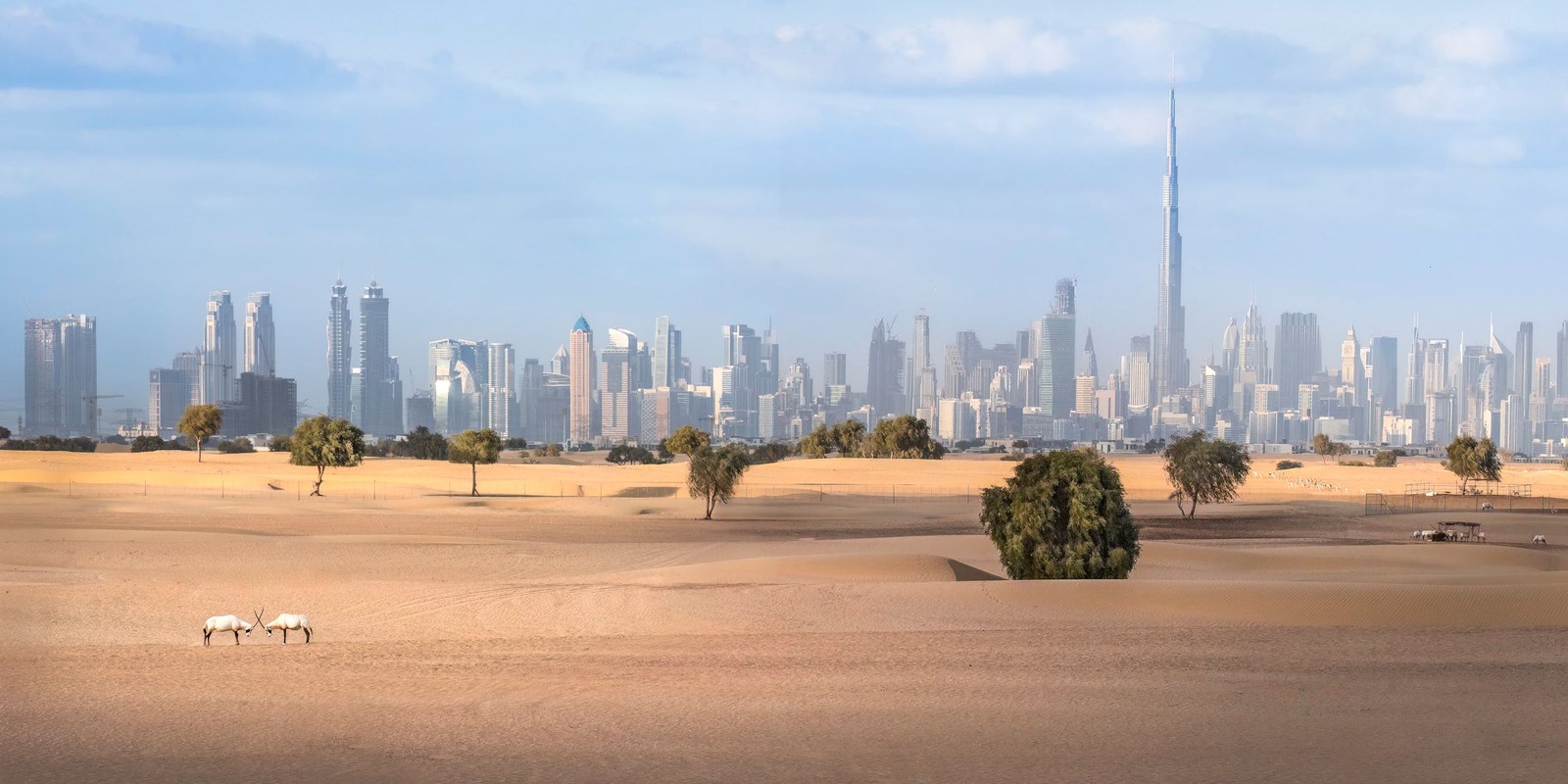
Dubai has two seasons rather than four: comfortable and extreme. From November to March it is one of the most reliable warm-weather cities on earth, with average highs in the twenties and almost no rain. From May to September, average highs sit around 40°C (104°F) and humidity turns the coast oppressive. Dubai weather rewards planning more than most destinations, because the difference between the right month and the wrong one is not a matter of degree — it changes what you can physically do with a day.
Dubai Weather Month by Month
Average daily highs and lows, rain days, sea temperature and sunshine hours. Scroll the table sideways on mobile.
| Month | Avg High | Avg Low | Avg Rain Days | Avg Sea Temp | Avg Sun Hrs | In a Word |
|---|---|---|---|---|---|---|
| January | 24°C (75°F) | 14°C (57°F) | 2 | 22°C (72°F) | 8 | Mild and bright; peak season |
| February | 25°C (77°F) | 15°C (59°F) | 2 | 22°C (72°F) | 8 | The most comfortable month |
| March | 28°C (82°F) | 18°C (64°F) | 2 | 23°C (73°F) | 9 | Warm; outdoor everything |
| April | 33°C (91°F) | 21°C (70°F) | 1 | 25°C (77°F) | 10 | Heating fast; sea inviting |
| May | 38°C (100°F) | 25°C (77°F) | <1 | 28°C (82°F) | 11 | Hot; outdoor time shrinking |
| June | 40°C (104°F) | 28°C (82°F) | <1 | 31°C (88°F) | 11 | Very hot; humidity building |
| July | 41°C (106°F) | 30°C (86°F) | <1 | 33°C (91°F) | 11 | Peak heat; indoors by day |
| August | 41°C (106°F) | 30°C (86°F) | <1 | 34°C (93°F) | 10 | Hottest sea; oppressive humidity |
| September | 39°C (102°F) | 27°C (81°F) | <1 | 33°C (91°F) | 10 | Still severe; easing late |
| October | 35°C (95°F) | 24°C (75°F) | 1 | 30°C (86°F) | 10 | Evenings become usable again |
| November | 30°C (86°F) | 20°C (68°F) | 2 | 27°C (81°F) | 9 | Excellent; season restarts |
| December | 26°C (79°F) | 16°C (61°F) | 3 | 24°C (75°F) | 8 | Mild; busiest and priciest |
The Best Time to Visit Dubai
For everything outdoors: November to March. Average highs of 24–30°C (75–86°F) make the beach, the desert, the old creek district and the rooftop bars all workable in the same day. February is the sweet spot — reliably warm, comfortable at night, and dry. One thing that surprises many visitors: Dubai’s UV index reaches 6–8 even in these comfortable winter months. Sunscreen is a year-round requirement here, not just a summer one.
For sea swimming: the Gulf is warm year-round and never really cold. It averages 22°C (72°F) even in midwinter, which is swimmable for most people, and climbs to a bath-like 34°C (93°F) in August — pleasant in principle, though by then the air is the problem.
For value and space: April, May, October. These shoulder months carry real heat but hotel rates fall sharply from the winter peak, and October in particular becomes usable again after about the 20th, when evenings cool.
Worth thinking twice about: June to September. Average highs of 39–41°C (102–106°F) combine with high humidity to produce feels-like figures well beyond the thermometer reading — our explainer on feels-like temperature covers why the gap gets so wide. This is not a season for walking tours.
If You Cannot Choose Your Month
A large share of Dubai visitors have no say in their dates — stopovers, business travel, school holidays. A summer trip is entirely doable; it simply runs on a different clock.
- Stuck with July or August? Treat the day as inverted: outdoors from 6am to 9am, indoors from 10am to 5pm, outdoors again after sunset. Dubai is built for this — malls, museums, aquariums and the metro are all air-conditioned, and the city genuinely comes alive at night.
- Desert trips in summer still work if they are sunrise departures rather than afternoon ones. Dune temperatures fall quickly after dark, so evening desert camps remain popular even in August.
- Humidity is the real enemy, not heat. August coastal humidity makes 41°C (106°F) feel considerably worse than the same temperature inland. If your dates are fixed, staying inland (Downtown rather than the Marina or the Palm) is measurably more comfortable.
- UV is simultaneously at its peak. From April through September, Dubai’s UV index regularly hits 11+ — the highest category — meaning unprotected skin can burn in under 10 minutes at midday. This applies even on hazy days when cloud cover gives a false sense of protection. See what UV index really means for travellers for a full breakdown of what each level requires.
- Arriving in a shamal? These northwesterly wind events kick up dust for a day or two at a time, mostly in winter and early summer. Outdoor visibility drops and desert trips are often cancelled; reschedule rather than push through.
Weather, Crowds and Price
Dubai’s best weather and its highest prices arrive together, and the gap is larger here than almost anywhere — peak-season hotel rates can run double the summer equivalent.
| Period | Weather | Crowds | Prices | Verdict |
|---|---|---|---|---|
| Nov–Dec | Warm and dry | Building to peak | Highest | Best weather, worst value |
| Jan–Feb | The most comfortable of the year | Peak | High | Book early or pay for it |
| Mar–Apr | Warm to hot; sea warming | Easing | Falling | Best all-round compromise |
| May & Oct | Hot but manageable at the edges | Light | Low | Best value if you plan around midday |
| Jun–Sep | Extreme heat and humidity | Minimal | Lowest | Only with an indoor-first itinerary |
Read across rather than down. If your priority is a beach and a pool with a functioning air-conditioned base, May and October buy you most of the experience at a fraction of February’s cost.
Humidity, Shamals and the Feels-Like Gap
Two things separate Dubai from a dry desert climate. The first is coastal humidity: the Gulf is shallow and very warm, so summer air holds far more moisture than the desert interior. That is why an August evening at 35°C (95°F) on the Marina can feel harder than midday inland — see our explainer on humidity and why it matters.
The second is the shamal, a northwesterly wind that lifts dust across the Gulf. It brings hazy skies, reduced visibility and occasional flight and excursion disruption, most often between December and March and again in early summer. It rarely lasts more than a couple of days.
Rain is genuinely rare — most months average two days or fewer — but when it comes it can be intense, and Dubai’s drainage is built for a dry climate. Occasional winter downpours cause short-lived flooding on roads.
What to Pack
Winter visits need less than people expect: light layers, plus something warmer for evenings, when January nights drop to around 14°C (57°F). Summer visits need sun protection, breathable fabrics, and a light layer for aggressively air-conditioned interiors. Dubai’s UV index peaks at 11+ between April and September — the highest category on the scale — meaning unprotected skin can burn in under 10 minutes at midday. SPF 50+ is not optional. Our hot-weather packing list covers the fabric choices in detail, and what UV index really means for travellers explains exactly what protection each level demands. If your trip lands in a genuine heat event, travelling in a heatwave sets out how to manage it safely.
Traveller Tip
Book a hotel with an outdoor pool that is chilled, not just heated. Between June and September, unchilled pool water can sit near 35°C (95°F) — warmer than a bath and useless for cooling down. The better summer hotels advertise chilled pools; it is the single most useful amenity in a Dubai summer.
WorldWeatherTime provides live conditions, feels-like temperature, humidity and 5-day forecasts for Dubai and destinations worldwide. Search your dates to see what the heat will actually feel like.