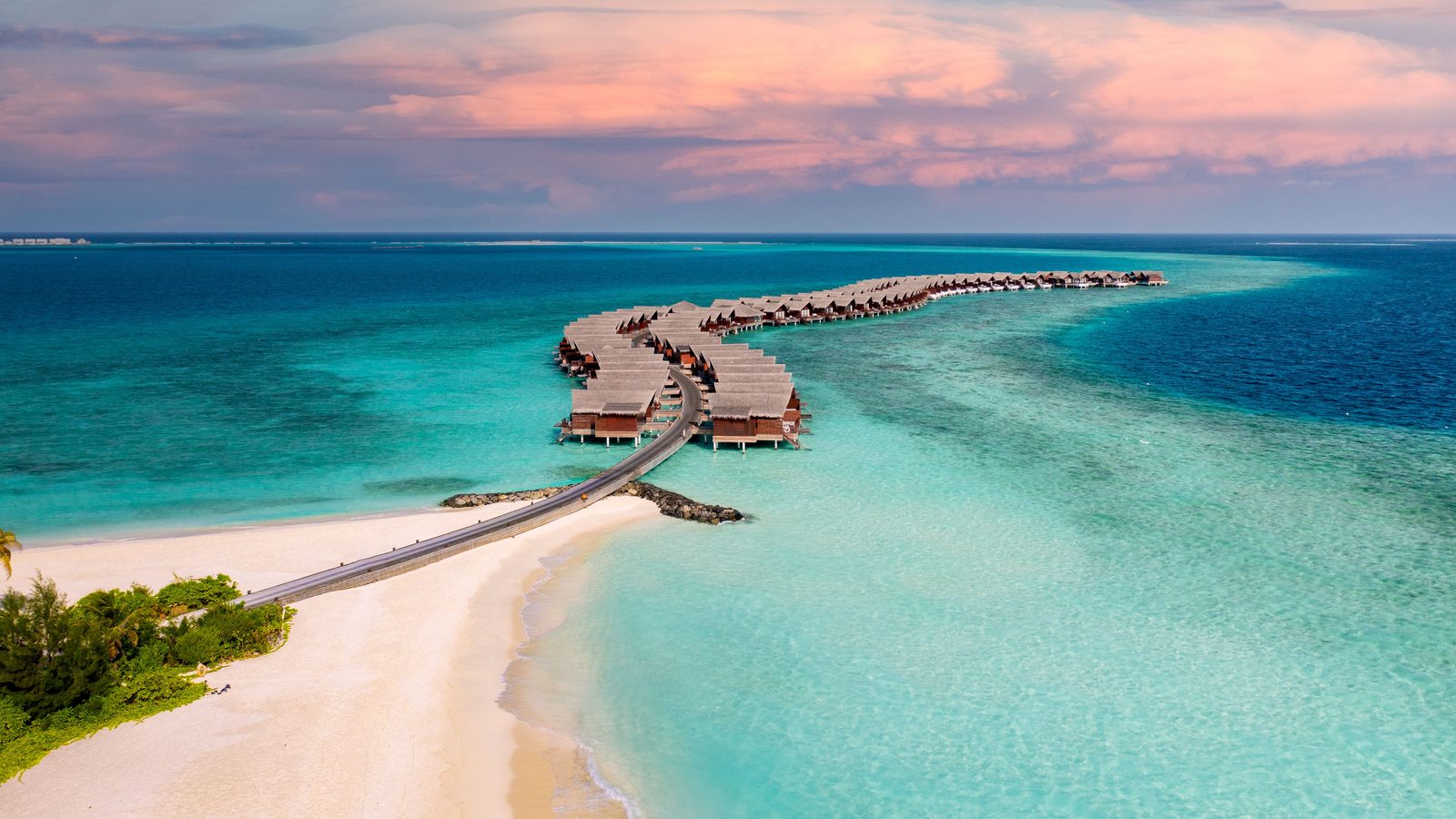
The Maldives barely has a “cold.” Temperatures hover around 30°C every single month of the year, and the sea never drops below about 27°C. So the question isn’t whether it’ll be warm — it will be. The real question is which monsoon you’re travelling into, because that’s what decides your sunshine, your sea conditions, and how much you pay.
Because the temperature stays flat year-round, a forecast tells you very little when you’re booking months ahead — you’re far better off learning the seasonal pattern and comparing the climate averages before you book. Here’s how the Maldives actually splits across the year.
The Two Monsoons That Shape a Maldives Trip
The Maldives has two seasons, both driven by monsoon winds rather than temperature. The northeast monsoon brings the dry season — calm seas, low humidity, and the most reliable sunshine. The southwest monsoon brings the wet season — more rain, higher humidity, rougher seas, and lower prices.
Worth knowing: the official Maldives Meteorological Service defines these fairly tightly — the dry northeast monsoon running roughly January to March, the wet southwest monsoon from mid-May to November, with December and April as transitional months. The travel industry usually rounds this to a simpler “dry season December–April, wet season May–November.” Both are useful; just don’t treat the boundaries as hard lines, because in recent years the monsoons have shifted later and grown less predictable.
Month by Month
Notice how little the temperature moves across the year — the whole story is in the rainfall and sea-condition columns.
| Month | Avg High | Sea Temp | Rainfall | Season |
|---|---|---|---|---|
| January | 30°C / 86°F | 28°C / 82°F | Low | Dry — peak season |
| February | 30°C / 86°F | 28°C / 82°F | Lowest | Dry — driest, best visibility |
| March | 31°C / 88°F | 29°C / 84°F | Low | Dry — hot, sunny |
| April | 32°C / 90°F | 30°C / 86°F | Low–moderate | Transitional — hottest month |
| May | 31°C / 88°F | 30°C / 86°F | High | Wet begins — storms possible |
| June | 30°C / 86°F | 29°C / 84°F | High | Wet — manta & whale sharks |
| July | 30°C / 86°F | 29°C / 84°F | High | Wet — hot, humid |
| August | 30°C / 86°F | 29°C / 84°F | High | Wet — strongest storms |
| September | 29°C / 84°F | 28°C / 82°F | Highest | Wet — cheapest, plankton-rich |
| October | 30°C / 86°F | 29°C / 84°F | High (short bursts) | Transitional |
| November | 30°C / 86°F | 28°C / 82°F | Moderate, easing | Turning dry |
| December | 29°C / 84°F | 28°C / 82°F | Low–moderate | Dry — festive peak |
The Dry Season (December–April): Peak Sun, Peak Prices
This is the postcard Maldives: clear blue skies, calm glassy lagoons, and 10–11 hours of sunshine a day from January to March. Underwater visibility is at its best, which makes it prime time for snorkelling and diving. February is typically the driest month and March the reliably sunny sweet spot; April is the hottest, nudging 32°C with humidity starting to build toward the change of season.
The catch is cost and crowds. December to February is the most expensive stretch of the year — rates are hiked for Christmas, New Year, and European winter-sun seekers, and the best resorts book out months ahead. If you want dry-season weather without festive-peak pricing, March or April (avoiding Easter) is the value window.
The Wet Season (May–November): Rain, Value, and Whale Sharks
“Wet season” sounds worse than it usually is. Rain in the Maldives tends to arrive as short, heavy bursts followed by sunshine rather than all-day grey — you’ll still get plenty of beach time between showers. What you’re really trading is reliability: seas are rougher, humidity sits around 80%, and there’s a genuine chance of a washed-out day or a passing storm, with September typically the wettest month.
In return, you get two real upsides. Prices drop sharply, and the plankton-rich waters draw manta rays and whale sharks, especially to spots like Hanifaru Bay in the Baa Atoll from around June to September — some of the best big-marine-life encounters of the year happen precisely when the weather is least reliable. The surf season also runs through these months. It’s the classic budget-versus-certainty trade-off.
Why the Maldives Isn’t One Forecast
Here’s the nuance most weather pages miss: the Maldives stretches over 800 km from north to south, straddling the equator, so a single forecast for the capital, Malé, won’t hold for the whole country. Rainfall actually increases as you go south — the southern atolls are the wettest overall — but they’re also less exposed to the southwest monsoon winds, which means in the middle of the wet season (say August) a far-southern resort can be sunnier and calmer than a northern one. If you’re heading to the far south, check conditions for Gan (Addu Atoll) rather than Malé. Each atoll has its own microclimate, and you can genuinely watch a shower fall on one island while the next stays dry.
One piece of good news across all of it: because the Maldives sits so close to the equator, it’s essentially outside the main cyclone belt, so major storms are rare.
Packing and Planning
Whenever you go, the sun is intense — the UV index here regularly hits 9–12, the “very high” band, so broad-spectrum sunscreen, a hat, and shade between 10am and 4pm aren’t optional. The humidity sits high year-round, so light, breathable fabrics make a real difference; our hot-weather packing list covers the essentials. And if you’re weighing the Maldives against another tropical two-season destination, Bali follows a similar wet/dry rhythm and is worth comparing.
TRAVELLER TIP
If you want guaranteed sunshine and money is no object, aim for February–March. If you want the same warm sea and empty beaches for far less — and don’t mind gambling on a few showers — the shoulder months of late April, early May, and November often give you dry-season conditions at wet-season prices. And if seeing manta rays or whale sharks is the dream, embrace the wet season: June to September is when they show up.
Sources
- Maldives Meteorological Service — monsoon seasons and climate normals (meteorology.gov.mv)
- Climates to Travel — Maldives climate and sea temperature (climatestotravel.com)
- Kuoni — Maldives weather by month (kuoni.co.uk)
- World Meteorological Organization — climate normals and standards (wmo.int)
WorldWeatherTime provides climate averages, sea temperature and live conditions for destinations worldwide. Search the Maldives — or compare it against anywhere else — to plan your trip around the weather.
Planning a Maldives escape?
Check live conditions, sea temperature and the seasonal outlook for any atoll